Contact Us

EV charging at your company HQ, professional management for fleets and employees

Turn your car park into managed e-mobility infrastructure, not a hallway of sockets.

As corporate fleets and employee personal cars go electric, the HQ car park stops being a property detail and becomes critical infrastructure. Installing chargers is only the first step. What sets a good programme apart is what comes next: how available power is distributed, who can charge when, and how consumption is billed or audited.

SOLX designs, installs and operates your company's charging park as a single system, with dynamic load balancing, access control, consolidated reports and priority management.

EV charging at your company HQ, professional management for fleets and employees

Why standalone chargers aren't enough

A company that installs 10 × 22 kW chargers in its car park is asking its electrical supply to handle 220 kW simultaneously. In practice:

The answer isn't to install fewer chargers. It's to install chargers that talk to each other and to the company.

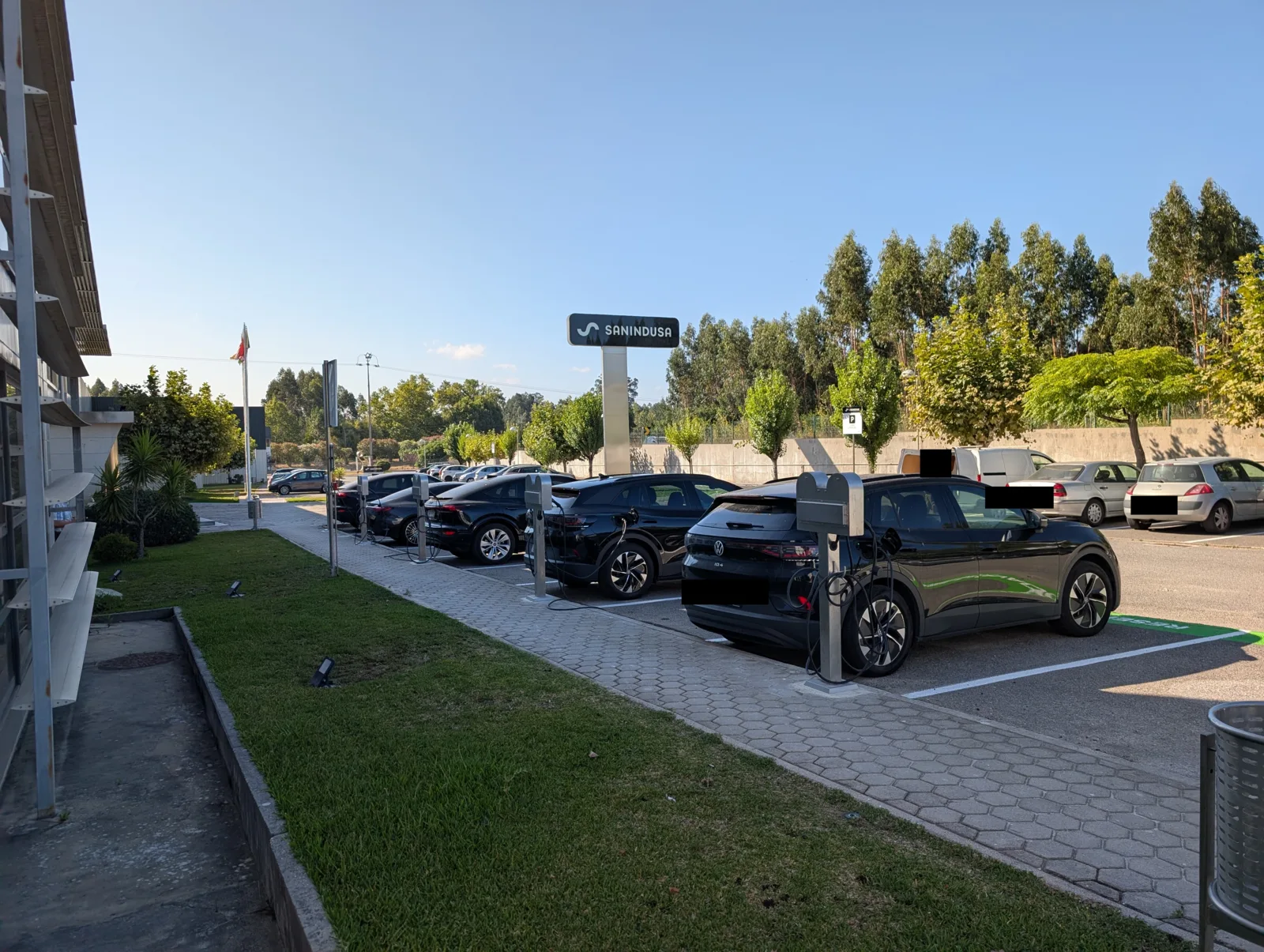
Real-world case, Sanindusa, Aveiro

Sanindusa, Indústria de Sanitários, S.A., one of Portugal's leading manufacturers of sanitary ware, chose SOLX to electrify charging at its corporate car parks across multiple sites (Aveiro Sul and Tocha, among others).

Chargers installed
35 × Urban Connect 22 kW three-phase, with 5 m Type 2 cable
Car parks covered
Multiple car parks across Sanindusa's industrial sites
Management
SOLX Park with dynamic load balancing, access control and reports
Priority rule
Bays 1 and 2 of each car park guarantee 11 kW continuous; remaining chargers share the rest dynamically
Connectivity
Ethernet + Wi-Fi + 4G (redundancy for chargers in low-coverage zones)
Schedule
Awarded December 2024, delivery and commissioning March to July 2025
SOLX team
Lúcio Ferrão (engineering), Pedro Figueirinha (account), Jorge Silva (field engineer)

What this means in practice: in a car park with 7 chargers installed and limited contracted power, the first two bays are reserved for priority cases (executive cars, vehicles in heavy rotation) with 11 kW continuous guaranteed. The remaining 5 bays charge normal vehicles, with the system automatically distributing available power based on how many cars are plugged in, never exceeding the contracted limit.

The SOLX solution

1

Dynamic load balancing

Dynamic load balancing lets a company install more chargers than the contracted power would support by brute force. Instead of each charger pulling its maximum independently, the system reads available power in real time and distributes it proportionally across the connected vehicles.

  • No power-upgrade cost in most cases
  • More chargers for the same electrical investment
  • Factory power peaks are protected: when machinery starts up, the system automatically lowers the power allocated to chargers
  • Integration with solar surplus: when the company has PV, the balancer prioritises the energy produced on site

At Sanindusa, this meant installing 35 × 22 kW chargers (theoretical sum of 770 kW) with no need to upgrade the contracted power at any of the sites.

2

Access control

Charging at the company car park goes from open-socket to authenticated service. Each user identifies themselves via mobile app or RFID card, and the system decides:

  • Whether they're authorised to charge
  • At which chargers
  • At what times
  • With which tariff (free for company fleet, at cost for employees, market price for visitors)

At Sanindusa, the programme administrators (Engineering + Maintenance) manage user profiles directly on the portal, with no need to call SOLX for every change.

3

Usage reports

The SOLX Park portal gives the company a control panel with:

  • Total consumption per charger, per user, per department, per car park, per day/week/month
  • Associated energy cost (configurable tri-hourly or single tariff)
  • Usage time vs idle time (occupancy rate)
  • CSV / Excel export for integration with expense or payroll systems
  • Metrics for ESG and CSRD reporting: kWh delivered, emissions avoided, number of unique users

Everything historical, auditable, with retention aligned with the company's accounting requirements.

4

Priority management

Not all charging sessions are equal. An executive with an afternoon offsite needs to leave with a full battery. The fleet car going out tomorrow morning can charge overnight on the off-peak tariff. An employee in hybrid work who's on site once a week has a different priority from one who's there every day.

  • Priority profiles: company fleet, executives, employees, visitors
  • Guaranteed minimum capacity, as at Sanindusa, where bays 1 and 2 of each car park have 11 kW reserved at all times
  • Time windows: turbo charging at lunchtime, eco during the night
  • Charger reservation: block a bay for a specific user in a time window
  • Scheduled charging: the car arrives at 9 am but the system only starts charging at 10 pm to catch the off-peak tariff

What your company gains

Want to structure your HQ's charging the way Sanindusa did?

We visit your car park, audit the current state, and return a turnkey proposal in two weeks.

Request a technical contact